
1The resilience you don’t see on LinkedIn
We talk a lot about resilience, usually after the difficult part is over. There’s a promotion, a new opportunity, a business launch, or some other milestone that makes for a compelling story. We see the outcome, with very little visibility into what it took to get there. But resilience develops through the repeated experience of trying something, falling short, learning, and approaching it differently the next time.
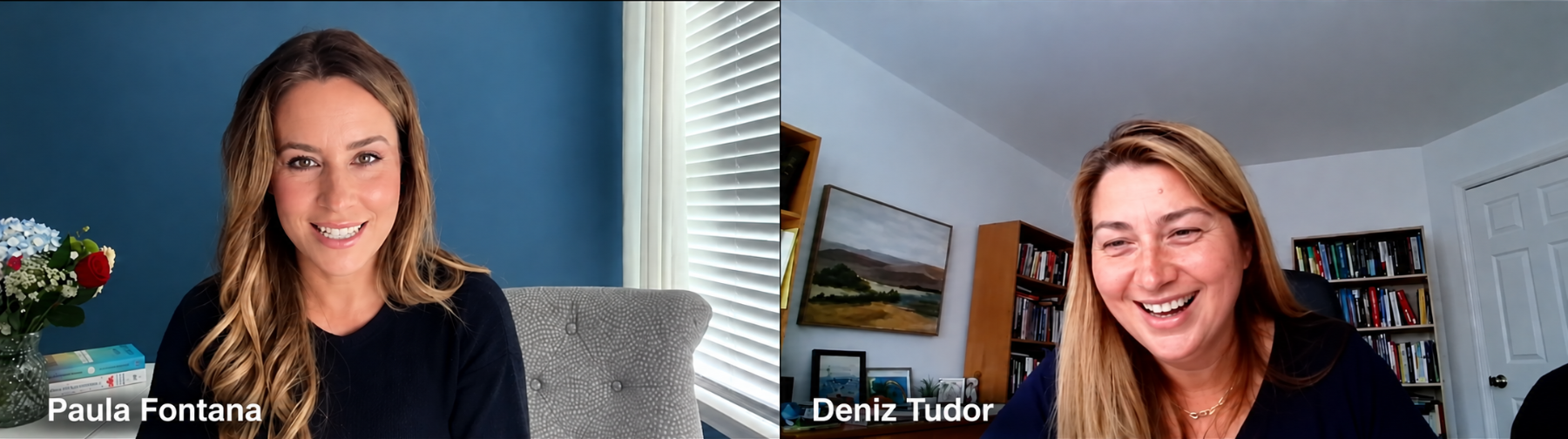
We begin with a conversation about leadership, the different experiences that shape us, and the idea that achieving something meaningful often requires becoming the person capable of managing it. Our walk-up songs capture that sentiment in different ways: Rascal Flatts’ “Here” and Elton John’s “I’m Still Standing.” And as Deniz points out, even the goals themselves change. The future we imagined 5 years ago may bear little resemblance to the one we’re working toward today.
2When everyone has AI, what actually sets you apart?
An advisor recently told Paula that Eudai needed to “pick one thing.” Paula’s response: the one thing is one logic. It’s reasonable advice in a world where business disciplines have relatively clear boundaries. But those boundaries are changing.
The one thing is one logic.
Take marketing. AI is making capabilities that once required significant resources accessible to almost everyone. Content is easier to produce, established approaches are losing effectiveness, and we’re seeing more of the same ideas recycled across companies. That raises a more interesting question: where does differentiation come from? We discuss 3 enduring sources of advantage: trust, unique expertise, and connection and community.
Deniz brings another dimension to the conversation: lived experience. The books we’ve read, the places we’ve been, the conversations we’ve had, and the time we’ve spent away from our devices all inform how we think and create. As more work becomes automated, these distinctly human inputs may become increasingly valuable. And perhaps the changing nature of organizational roles calls for something new altogether: a Chief Uncharted Officer.
3Doomscrolling is not a strategy
The AI headlines seem to get more dramatic by the week. Predictions of widespread job displacement, existential threats, and technological catastrophe have become part of the regular news cycle. Having both spent much of our careers thinking about risk, we’re interested in the distinction between identifying consequential risks and amplifying fear.
Deniz draws on her background in economics and the book Shocks, Crises, and False Alarms to examine why predictions of impending crises attract attention, and why we should consider the incentives behind them. There are legitimate risks associated with AI. There are also meaningful questions about probability, timing, and what we can actually influence. If we’re concerned about AI reshaping employment, for example, workforce preparation and reskilling deserve attention today.
The value comes from the process of planning itself.
That brings us back to scenario planning. In business continuity, we’ve long understood that the value comes from the process of planning itself. Working through possible outcomes develops the judgment, adaptability, and muscle memory needed when circumstances change. The same principle applies to careers, organizations, and the decisions we’re making about emerging technology.
4Risk no longer stops at the organizational boundary
One of the more consequential shifts we’re seeing with AI is how risk extends across organizations. Companies increasingly depend on a relatively small number of technology providers. Their decisions, practices, and internal cultures can have implications for everyone relying on their systems.
Deniz raises the question of conduct risk at an industry-wide scale. How much of our future depends on the judgment and integrity of people working inside organizations over which we have relatively little control? We discuss the growing number of conscientious objectors emerging from AI companies, how public attitudes toward them compare with whistleblowers and objectors of the past, and what that may tell us about the changing relationship between technology companies and society.
The conversation ends with a question from one of Deniz’s students: What happens if you join a company whose values you don’t share? It’s a question we wish more people were asking. And perhaps a fitting place to end our first episode.
The question we’re left with: As the future becomes harder to predict, are we spending enough time developing the judgment and capabilities to navigate it?