
1The portfolio economy is taking shape
LinkedIn’s CEO recently described portfolio careers as a growing trend. The platform has also introduced the ability to feature multiple current roles on a profile. It’s a relatively small product change that reflects something much bigger happening in the workforce.
Layoffs, slower hiring, and changing expectations about careers are pushing more people to explore alternatives to traditional employment. At the same time, AI is making capabilities that once required entire teams accessible to individuals and small businesses. We’re seeing startups accomplish more with fewer people, and experienced professionals finding new ways to apply their expertise across organizations.
The expertise itself remains valuable. What’s changing is how companies access it.
We talk about why the term “fractional” doesn’t quite capture this evolution, and why a portfolio career doesn’t necessarily have to be a permanent destination. For some, it’s a way to build a business. For others, it’s an opportunity to develop new skills, explore different interests, or create flexibility during a particular stage of life.
Deniz also makes the case that if you’ve been thinking about starting something, the next couple of years may offer an unusually interesting window of opportunity.
2The real cost of AI may be outside your business case
One of the more interesting conversations Paula encountered at a recent gathering of private board directors involved the unexpected economics of AI investment. She shares an example involving Blue Cross Blue Shield, where AI adoption was associated with higher claims costs as healthcare providers also adopted AI and changed how they submitted claims.
What happens when everyone in your ecosystem is investing in the same technology?
Organizations typically assess technology investments through their own expected efficiencies, productivity gains, and financial returns. But customers, suppliers, competitors, and other stakeholders are making investments of their own. Their changing behavior can materially affect the economics of yours.
Deniz connects this to another problem: AI investments that begin with the technology rather than a clearly defined business need. When investment decisions are driven by fear of missing out, disappointing returns shouldn’t come as a surprise. The discussion raises broader questions about strategy, interdependence, and whether our conventional approaches to evaluating technology investment are keeping pace with the systems we’re changing.
3The conference is over. What actually changed?
The cancellation of the Grace Hopper Celebration, reportedly driven by insufficient sponsorship and registration, prompted a larger conversation about the economics of community and organizational change. For years, Grace Hopper has been an important gathering for women in technology. Its cancellation raises questions about how organizations prioritize, fund, and sustain the communities they say matter.
But there’s another dimension worth exploring. We spend considerable time and resources bringing people together to discuss problems. Conferences, panels, summits, and industry initiatives create visibility, connections, and momentum. What happens when everyone goes home?
Having spent much of our careers helping organizations navigate change, we’ve seen how difficult it can be to translate those conversations into meaningful action. There’s considerable enthusiasm for announcing initiatives, launching programs, and sharing ideas. Sustaining the organizational effort required to make those ideas work is considerably harder.
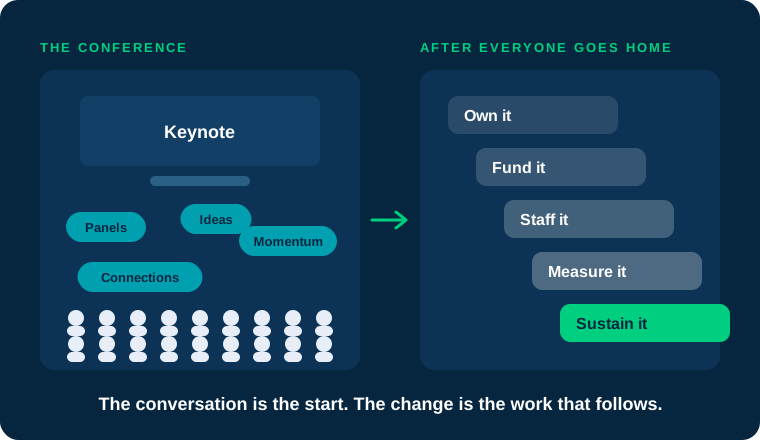
If we invested as much in implementing change as we do in talking about it, how much further along would we be?
4Diversity, networks, and the people we already know
The conversation turns to the environments we create and the opportunities we make available to others. At a recent Private Directors Association conference, Paula shared findings from research conducted with Arizona State University’s New Governance Lab, the basis for Director, Defined.
It’s an interesting illustration of the distance between identifying a priority and changing the practices that influence outcomes. We discuss the importance of being deliberate about the people, ideas, and experiences we bring into our professional environments.
Deniz shares how she assembled a diverse advisory group by seeking out people with the strongest expertise in their respective fields. Paula reflects on the role that intentionally cultivating new relationships has played in her own career. Sometimes that starts with following someone whose ideas challenge your thinking, reaching out for a conversation, or becoming an advocate for someone who might otherwise be overlooked. After all, that’s how the two of us met.
We also explore the limitations of professional communities that become too insular, and the responsibility we each have to create opportunities beyond our immediate circles.
5Turning expertise into something useful
The conversation ultimately comes back to action. There are plenty of consequential problems to work on, and more opportunities than ever to apply our expertise in different ways.
Deniz suggests bringing AI capabilities to nonprofits and small businesses that may not otherwise have access to them. We discuss how contributing to new communities can create opportunities to learn, develop professionally, and make a meaningful difference.
It’s also a reminder that change rarely happens all at once. It happens through the decisions we make, the people we include, and the effort we sustain long after the conference ends.
Our challenge for the week: Pick one problem you care about and do something tangible to move it forward.